Quantum Circuits Inc. Achieves 99.99% Gate Fidelity on Superconducting Qubits, Ushering in New Era of Precision
Palo Alto-based startup Quantum Circuits Inc. announced 99.99% single-qubit gate fidelity on a commercially manufactured superconducting qubit chip—the first time such high fidelity has been achieved outside ultra-specialized academic labs.
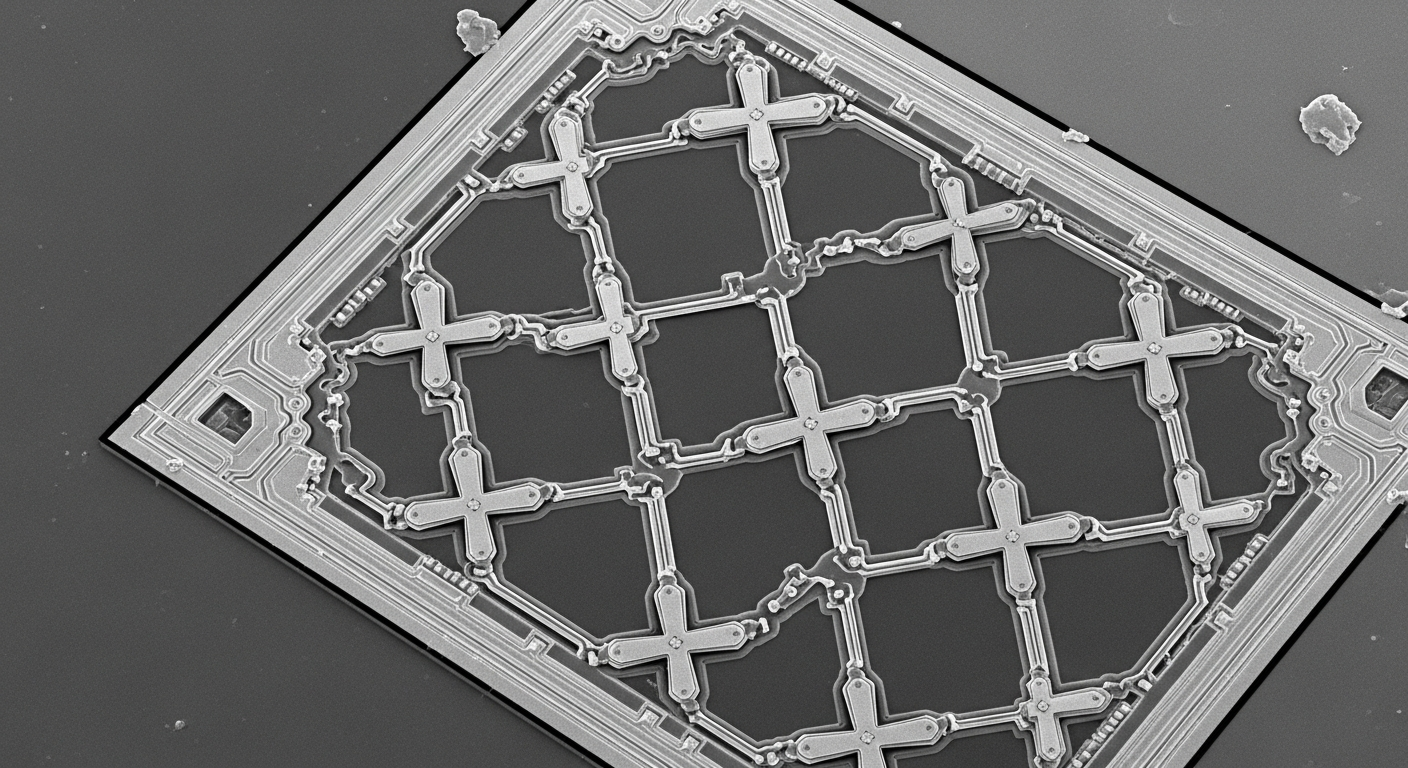
The hardware landscape of quantum computing saw a major shift this month when Palo Alto-based startup Quantum Circuits Inc. (QCI) announced that they have achieved 99.99% single-qubit gate fidelity on a commercially manufactured superconducting qubit chip. This level of precision was previously only attainable in ultra-specialized academic laboratories under carefully controlled conditions with custom-fabricated devices. QCI's achievement represents the first time such high fidelity has been demonstrated on a chip designed for scalable manufacturing.
The key innovation behind this breakthrough is QCI's proprietary three-dimensional resonator architecture. Traditional superconducting qubits use planar resonators—essentially, the qubit and its control circuitry are all fabricated on the same two-dimensional surface. This creates parasitic interactions between qubits and their control lines, introducing noise and limiting gate fidelity. QCI's approach lifts the control circuitry into a third dimension, creating physical separation between the qubits themselves and the electronics used to manipulate them.
Dr. Robert Schoelkopf, co-founder of Quantum Circuits Inc. and Sterling Professor of Applied Physics at Yale University, explained the significance: "The limitation in superconducting qubits has never been the qubits themselves. It's been the environment around them. Every wire, every amplifier, every microwave line introduces noise that degrades coherence. By moving the control circuitry into a separate physical plane, we've essentially created a cleaner environment for the qubits to operate in. The result is that our qubits behave much closer to their theoretical maximum performance."
The 99.99% gate fidelity figure is not merely an incremental improvement. In quantum computing, gate fidelity follows a logarithmic relationship with error rates. A gate fidelity of 99.9% yields an error rate of 0.1% per gate; 99.99% yields an error rate of 0.01% per gate. This tenfold reduction in error rate has outsized effects on the feasibility of error correction. With 99.99% gate fidelity, the overhead required for error correction drops dramatically, meaning fewer physical qubits are needed to create each logical qubit.
Independent verification of QCI's claim is ongoing, with initial results from third-party testing labs reportedly confirming the fidelity numbers. The company has stated that they will make their test data publicly available through a preprint server within the coming weeks, a move that reflects confidence in their results and a commitment to transparency.
The commercial implications of this achievement are substantial. QCI has been operating with a relatively low profile compared to industry giants like IBM and Google, focusing instead on developing their unique hardware architecture. With this announcement, they have signaled that they are ready to compete at the highest level. The company has already begun scaling up manufacturing capacity, with plans to release a 100-qubit system based on this new architecture by the end of 2026.
Industry analysts have noted that QCI's approach has particular advantages for quantum networking and distributed quantum computing. Because their three-dimensional architecture naturally separates control electronics from qubits, it may be easier to integrate optical interconnects and create modular quantum processors that can be linked together—a crucial capability for building truly large-scale quantum computers.