Microsoft & Quantinuum Unveil "Flock of Qubits": Error Rates Reduced by 800x, Logical Qubits Become Practical
Microsoft and Quantinuum jointly announced a new error correction architecture called 'Flock of Qubits,' achieving error rates 800 times lower than underlying physical qubits while using just 30 physical qubits to create four logical qubits.
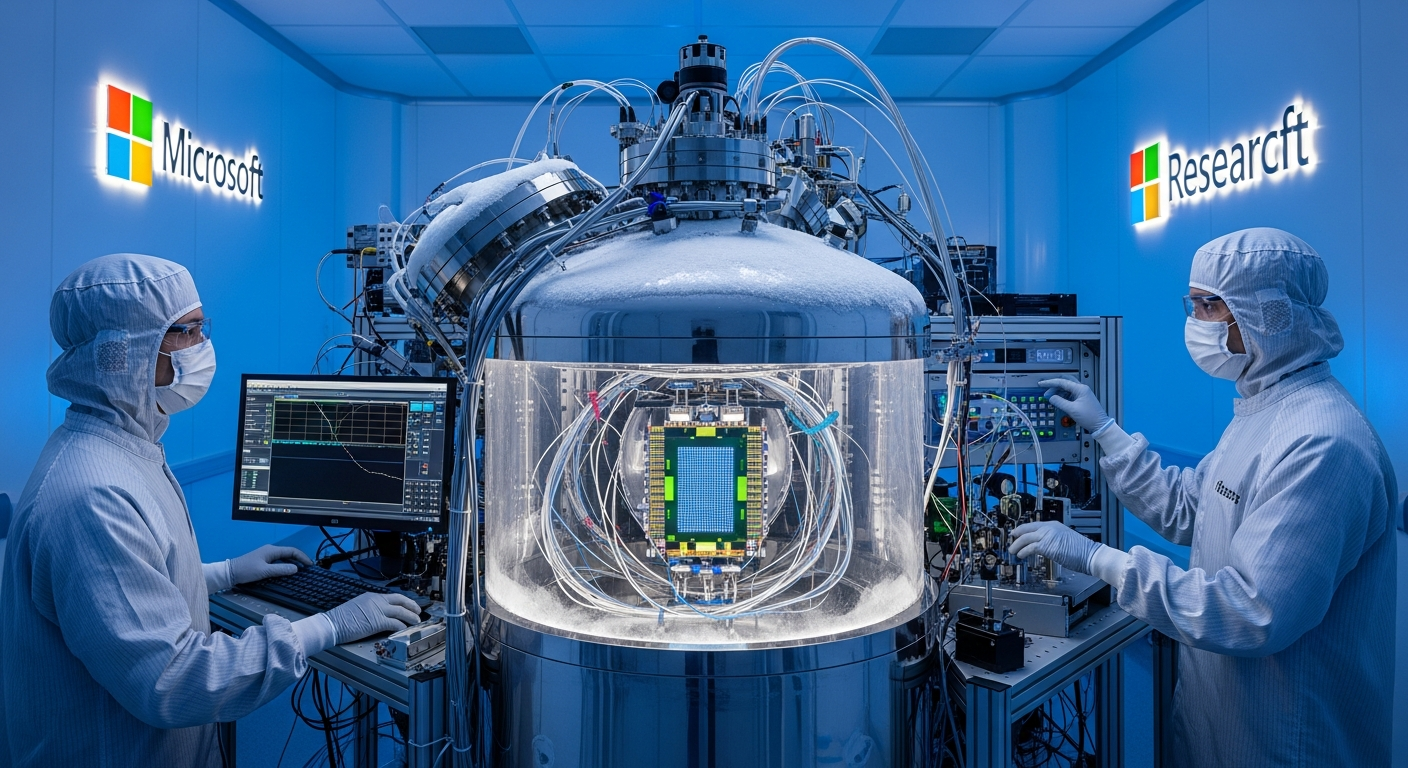
Perhaps the most significant technical achievement of the past month came from the partnership between Microsoft and Quantinuum, who jointly announced a new error correction architecture called "Flock of Qubits." For years, the quantum computing industry has been chasing a singular goal: making logical qubits reliable enough to perform useful computations. Physical qubits—whether superconducting transmon, trapped ion, or topological—are inherently fragile. They decohere, they pick up noise from their environment, and their gate operations are never perfect. Error correction schemes have existed in theory since the 1990s, but implementing them at scale has proven extraordinarily difficult.
The Flock of Qubits architecture represents the first time a system has demonstrated that logical qubits can achieve error rates low enough for practical computation while maintaining a reasonable physical qubit overhead. The system uses 30 physical qubits—in this case, Quantinuum's trapped-ion qubits, which are known for their long coherence times and high gate fidelities—to create four logical qubits. These four logical qubits were then used to run quantum circuits while maintaining error rates 800 times lower than the underlying physical qubits.
What makes this breakthrough particularly notable is the architecture's unique approach to error correction. Traditional surface code error correction, which has been the industry standard, requires a large two-dimensional grid of physical qubits to protect each logical qubit, with significant overhead for boundaries and connections. The Flock of Qubits approach instead uses a modular, nested structure where groups of physical qubits form "flocks" that collectively encode logical information. Errors are detected and corrected in real-time by monitoring the relationships between qubits within each flock, rather than relying on a rigid grid structure.
Dr. Krysta Svore, Vice President of Advanced Quantum Development at Microsoft, described the achievement in a press briefing: "What we've demonstrated is that error correction is no longer just a theoretical exercise. We can now build logical qubits that are genuinely better than the physical qubits they're made from. That's the fundamental requirement for scalable quantum computing. If you can't make logical qubits that outperform physical ones, you can never scale to the millions of qubits needed for useful applications. With Flock of Qubits, we've crossed that threshold."
Quantinuum CEO Dr. Rainer Blatt added: "The industry has been debating for years whether fault-tolerant quantum computing is five years away or twenty years away. What we're showing today is that the architecture is here. The engineering challenges remain significant, but the physics is no longer the limiting factor. We now have a clear path to building systems with hundreds of logical qubits within the next three to five years."
The announcement prompted immediate reactions across the quantum industry. IBM, which has been developing its own error correction roadmap based on surface codes, acknowledged the significance of the achievement while noting that different approaches have different trade-offs. Google Quantum AI's team congratulated the Microsoft-Quantinuum collaboration and noted that their own error correction research continues to progress. Rigetti, IonQ, and other quantum hardware companies all released statements indicating that they are exploring similar logical qubit architectures.
Perhaps most importantly, Microsoft simultaneously announced that the Flock of Qubits architecture will be integrated into Azure Quantum, making it available to researchers and developers through the cloud. This means that for the first time, developers will be able to run algorithms on logical qubits without needing to understand the underlying error correction implementation—a crucial step toward making quantum computing accessible to a broader audience.