Simulating Nature with Nature: How Quantum Computers Model the Quantum World
Richard Feynman's original vision for quantum computing was to simulate nature at the atomic level. That vision is now becoming reality—with profound implications for materials and medicine.
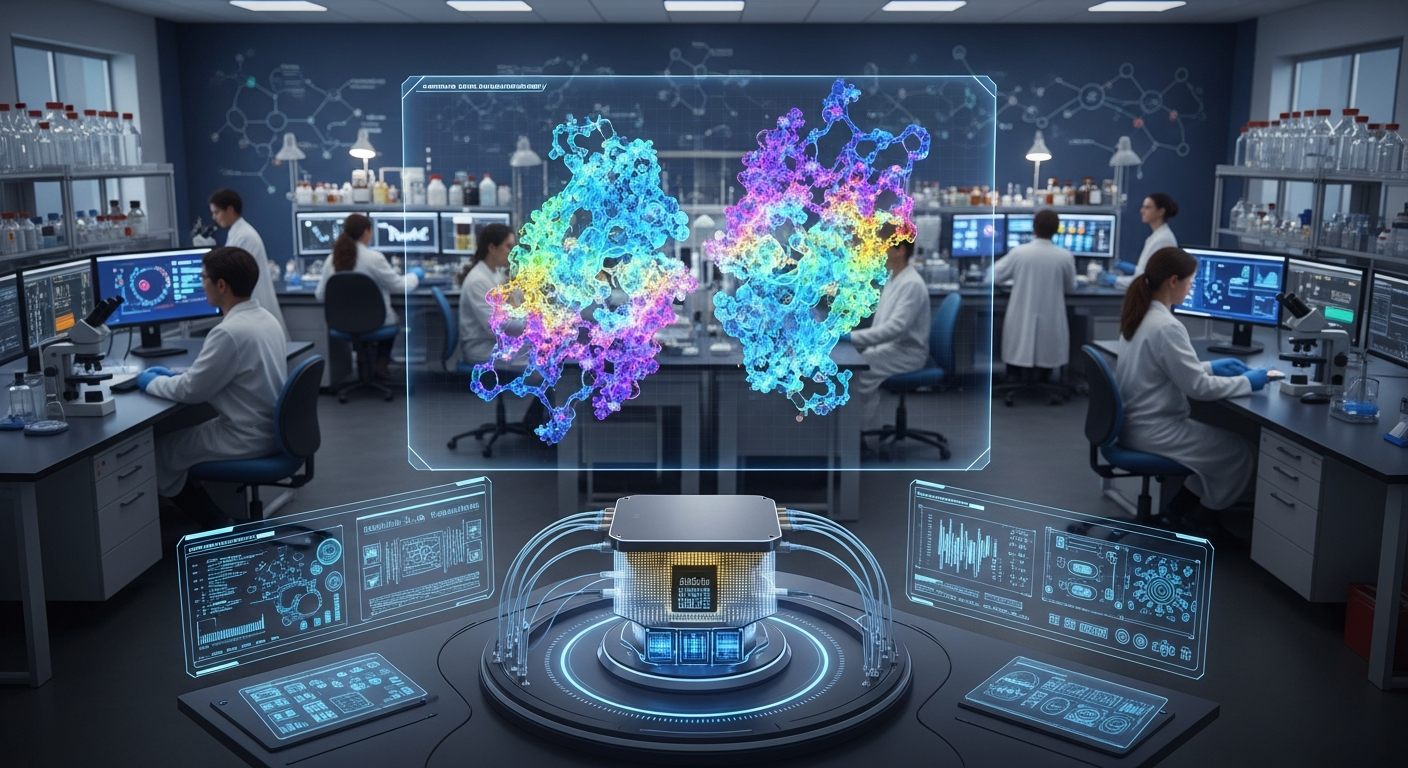
Some of the most important problems in science and engineering involve quantum mechanics. How does a new drug bind to a protein? What makes a material superconducting? How can we design better batteries or more efficient solar cells?
These questions are fundamentally quantum. They involve electrons moving around atoms, molecules interacting, and quantum effects determining the final outcome. Classical computers struggle to answer them. The reason is simple: quantum systems are exponentially complex. Simulating them on classical computers quickly becomes impossible.
This is where quantum simulation comes in. If you want to understand a quantum system, why not use another quantum system to model it? This is the idea behind quantum simulation: using a controllable quantum computer to mimic a less controllable quantum system.
The Exponential Problem
To understand why quantum simulation is necessary, we need to understand what makes quantum systems hard for classical computers.
Imagine you have a molecule with 100 electrons. To fully describe the quantum state of these electrons, you need to specify the probability of every possible configuration. Each electron can be in different states, and they all interact with each other. The number of possible configurations grows exponentially with the number of electrons. For 100 electrons, the number is astronomical—far larger than the number of atoms in the universe.
Classical computers can't handle this exponential explosion. They use approximations—like density functional theory or quantum Monte Carlo—that simplify the problem. These approximations work well for some systems but fail for others. For many important problems—like high-temperature superconductors or complex catalysts—the approximations are not good enough.
Feynman's Vision
In 1982, physicist Richard Feynman gave a famous lecture titled "Simulating Physics with Computers." In it, he argued that classical computers would never be able to efficiently simulate quantum systems. His proposed solution: build a computer that itself operates on quantum principles. "Nature isn't classical, dammit," he said, "and if you want to make a simulation of nature, you'd better make it quantum mechanical."
This is the founding vision of quantum simulation. Use a quantum computer to directly represent quantum states. Let the computer's own quantum evolution mirror the evolution of the system you want to understand. If you can control your quantum computer well enough, you can simulate systems that are completely out of reach for classical computers.
How Quantum Simulation Works
A quantum simulator is essentially a quantum computer programmed to behave like another quantum system. The process has three main steps:
Encoding: You map the system you want to simulate onto the qubits of your quantum computer. Each qubit might represent an electron, or a lattice site, or some other degree of freedom. The interactions between particles in the real system become interactions between qubits.
Evolution: You apply a sequence of quantum gates that mimics the time evolution of the real system. This is like solving the Schrödinger equation—the fundamental equation of quantum mechanics—but doing it with quantum hardware rather than classical calculations.
Measurement: You measure the qubits to extract the information you need. This might be the energy of the system, the probability of a certain configuration, or some other observable property.
Because the quantum computer is itself a quantum system, it can represent the state of the target system efficiently. Instead of storing an exponentially large wavefunction, the quantum computer simply is the wavefunction.
Types of Quantum Simulators
There are two main approaches to quantum simulation:
Analog quantum simulators: These are purpose-built devices designed to simulate specific types of quantum systems. They aren't fully programmable quantum computers. Instead, they are engineered to behave like a particular model system. For example, atoms trapped in laser beams can be made to behave like electrons in a crystal. Analog simulators are easier to build and can simulate larger systems than digital simulators. But they are less flexible.
Digital quantum simulators: These are programmable quantum computers. You write a quantum algorithm that implements the simulation. Digital simulators are more flexible—you can simulate many different systems with the same hardware—but they require more qubits and better error correction.
Real-World Applications
Quantum simulation is not just a theoretical idea. It's already being used to tackle real problems.
Battery materials: In early 2026, researchers at the Fraunhofer Institute used a quantum simulator to study lithium-ion diffusion in battery cathodes. They discovered that certain atomic defects actually help lithium move faster, pointing the way to faster-charging batteries.
Drug discovery: Pharmaceutical companies are exploring quantum simulation to understand how potential drugs bind to protein targets. This could dramatically accelerate the discovery of new medicines.
High-temperature superconductors: These materials conduct electricity without resistance at relatively high temperatures. Understanding why they work could lead to revolutionary technologies, but the physics is so complex that classical computers have made limited progress. Quantum simulators could finally crack this problem.
Catalysts: Many industrial processes—from fertilizer production to carbon capture—rely on catalysts. Quantum simulation could help design catalysts that work better and use less energy.
The Current State
We are still in the early days of quantum simulation. Today's quantum computers are small and noisy. They can't yet simulate systems larger than a few dozen particles with high accuracy. But the field is advancing rapidly.
The development of better error correction—like Microsoft and Quantinuum's "Flock of Qubits"—will allow longer, more accurate simulations. The scaling of qubit counts—toward hundreds and then thousands—will allow larger systems to be simulated. And the development of better algorithms will make simulations more efficient.
The Future
As quantum hardware improves, quantum simulation will become an increasingly powerful tool. It will enable:
- Discovery of new materials: Instead of years of trial-and-error, researchers could screen thousands of candidate materials in simulation before synthesizing the most promising ones.
- Understanding of fundamental physics: Problems that have resisted understanding for decades—like high-temperature superconductivity—could finally be solved.
- Design of better catalysts: More efficient chemical processes that save energy and reduce pollution.
- Accelerated drug development: Faster discovery of new medicines for diseases that currently have no treatments.
Conclusion
Quantum simulation is perhaps the most direct application of quantum computing. It's Feynman's original vision: using nature to simulate nature. It doesn't require breaking cryptographic codes or discovering new algorithms. It just requires building quantum computers that are good enough to mimic the quantum systems we want to understand.
As quantum hardware improves, quantum simulation will move from laboratory demonstrations to practical tools. It will become as essential to materials science and chemistry as microscopes are to biology. And it will open doors to discoveries that we can barely imagine today.