Deep Learning: How Neural Networks with Many Layers Are Changing AI
Deep learning uses layered neural networks to automatically learn features from raw data. It is the technology behind voice assistants, image recognition, and modern language models.
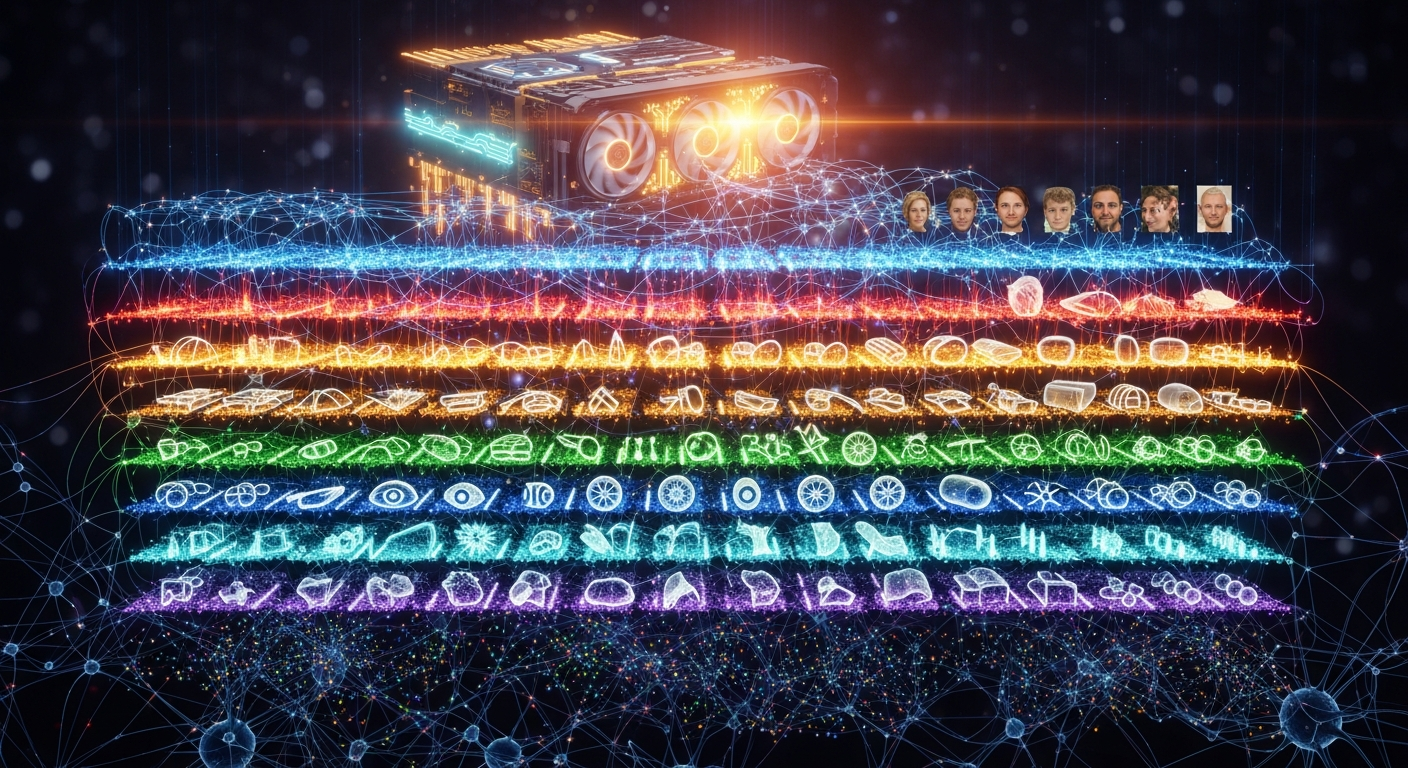
If machine learning is the idea that computers can learn from data, deep learning is the technology that made that idea practical. Deep learning uses artificial neural networks with many layers to automatically discover patterns in data. It's the technology behind voice assistants that understand your words, cameras that recognize your face, and translation tools that convert text between languages.
To understand deep learning, we need to understand what neural networks are, why having many layers matters, and how this technology has transformed artificial intelligence.
What Is a Neural Network?
An artificial neural network is inspired by the brain. In the brain, neurons receive signals from other neurons, process those signals, and send output to other neurons. Networks of neurons can learn to recognize patterns, control movement, and perform complex computations.
An artificial neural network mimics this structure. It has:
- Inputs: The data you want to process—pixels in an image, words in a sentence, sensor readings from a robot.
- Neurons: Simple processing units that take inputs, multiply them by weights, add a bias, and pass the result through an activation function.
- Layers: Groups of neurons that process inputs together. Information flows from the input layer, through hidden layers, to the output layer.
- Weights: The parameters that the network learns. Each connection between neurons has a weight that determines how much influence one neuron has on another.
The network starts with random weights. As it sees examples, it adjusts the weights to make its predictions better. After training on enough examples, the weights encode the patterns in the data.
The Problem with Shallow Networks
For decades, researchers struggled with neural networks. They worked on simple problems but failed on complex ones. The reason: shallow networks—networks with only one or two hidden layers—couldn't learn complex patterns.
Think of it like this: a shallow network can learn simple relationships. It can learn that dark pixels at certain positions mean "cat." But it can't learn the hierarchical structure of a cat—the eyes, the ears, the fur, the shape. That requires multiple layers, each learning a different level of abstraction.
Why Depth Matters
A deep neural network has many hidden layers—sometimes dozens or hundreds. Each layer learns a different level of abstraction:
- The first layer learns simple patterns: edges, corners, blobs of color.
- The second layer learns combinations of simple patterns: eyes, noses, wheels, windows.
- The third layer learns larger structures: faces, cars, buildings.
- The fourth layer learns even more complex concepts: specific breeds of cats, models of cars, types of architecture.
This hierarchical learning is what makes deep networks so powerful. They can learn to represent extremely complex patterns by combining simple patterns in structured ways.
How Deep Learning Works
Training a deep neural network is challenging. The networks are huge—millions or billions of parameters. The data is vast—millions of images, billions of words. And the mathematics is complex—nonlinear functions, gradient calculations, optimization.
The process uses a technique called backpropagation:
- Feed an input through the network to get a prediction.
- Compare the prediction to the true label to calculate the error.
- Propagate that error backward through the network, calculating how much each weight contributed to the error.
- Adjust each weight slightly to reduce the error.
- Repeat for millions of examples, thousands of times.
This simple algorithm, combined with massive amounts of data and computing power, has produced the remarkable results we see today.
Why Deep Learning Exploded Now
Deep learning has been around since the 1980s. So why did it explode in the 2010s?
More data: The internet created datasets of unprecedented size. ImageNet, a dataset of 14 million labeled images, became the training ground for deep learning. Language models trained on billions of web pages.
More compute: Graphics processing units (GPUs) originally designed for video games turned out to be perfect for training deep networks. A single GPU could do the work of thousands of CPUs.
Better algorithms: Researchers solved problems that had plagued deep networks. Better activation functions allowed gradients to flow through many layers. Better initialization schemes helped networks start in good places. Better optimization methods made training faster and more stable.
Breakthrough Architectures
Deep learning isn't one thing. It's a family of architectures, each suited to different types of data:
Convolutional Neural Networks (CNNs): These are designed for images. They use mathematical operations called convolutions to detect patterns regardless of where they appear in the image. A CNN can recognize a cat whether it's in the center of the photo or in the corner.
Recurrent Neural Networks (RNNs): These are designed for sequences. They have loops that allow information to persist across time steps. They were the standard for language and audio before transformers came along.
Transformers: These are the current state of the art for language and many other domains. Instead of processing sequences step-by-step, transformers use attention mechanisms to look at all parts of the input simultaneously. This allows them to capture long-range relationships that RNNs struggle with.
The Impact of Deep Learning
Deep learning has transformed artificial intelligence:
Computer vision: Before deep learning, computer vision was a struggle. Recognizing objects in images was a hard problem. Now, systems can not only recognize objects but also describe scenes, generate realistic images, and even create videos.
Natural language processing: Language models have gone from struggling with simple sentences to generating coherent essays, answering complex questions, and even writing code.
Speech recognition: Voice assistants that once understood only simple commands now handle natural conversation. Speech recognition accuracy has gone from 80% to near-human levels.
Scientific discovery: Deep learning is accelerating research in biology, chemistry, physics, and medicine. It's predicting protein structures, discovering new materials, and helping doctors diagnose diseases.
Limitations of Deep Learning
Despite its power, deep learning has important limitations:
Data hungry: Deep learning models need vast amounts of labeled data. This is expensive and often impractical.
Brittle: Deep learning models can fail in surprising ways. A model that recognizes objects in images can be fooled by small, imperceptible changes to the input.
Black box: It's hard to understand why a deep network made a particular decision. This is a problem for high-stakes applications.
Energy intensive: Training large deep learning models consumes enormous amounts of energy. The carbon footprint of training a single large language model can be equivalent to the lifetime emissions of several cars.
The Future
Deep learning continues to evolve. Researchers are working on:
- Few-shot learning: Models that learn from just a few examples, not millions.
- Explainable AI: Models that can explain their decisions in human-understandable terms.
- Efficient models: Smaller models that run on phones and edge devices, consuming less energy.
- Multimodal models: Models that understand images, text, and audio together, learning the relationships between different types of data.
Deep learning has come a long way in a short time. But we're still in the early stages. The next decade will bring even more remarkable advances, as deep learning continues to push the boundaries of what computers can do.