Computer Vision: How Machines Learn to See
From detecting edges to understanding entire scenes, computer vision has advanced dramatically thanks to deep learning—enabling self-driving cars, medical imaging, and beyond.
When you look at a photo, you don't think about what's happening. You just see. Instantly, effortlessly, you know what's in the image: there's a cat sitting on a rug, a coffee cup on a table, a window with light coming through. You don't need to consciously analyze edges or colors or shapes. You just see.
For computers, this is incredibly hard. A digital image is just a grid of numbers—three numbers per pixel for red, green, and blue. How do you go from that grid to understanding that there's a cat in the image? This is the problem that computer vision tries to solve.
The Challenge of Vision
To understand why computer vision is so hard, think about what's involved in recognizing a cat:
- Cats come in different sizes, colors, and breeds.
- Cats can be in different positions—sitting, standing, lying down, stretching.
- Cats can be partially hidden behind objects.
- Lighting can vary dramatically.
- The background can be cluttered and confusing.
A human can handle all this variation without thinking. A computer needs to learn to handle it. And unlike humans, computers don't have built-in knowledge about what cats look like, what the world is like, or how objects behave.
The Traditional Approach
Before deep learning, computer vision relied on hand-crafted features. Researchers would design algorithms to detect edges, corners, and other low-level structures. Then they'd combine these features to detect more complex patterns. Then they'd use machine learning to classify the resulting patterns.
This approach worked for limited problems but didn't scale. Designing features for every new problem was time-consuming and required deep expertise. And the systems were brittle—they worked well in controlled conditions but failed in the messy real world.
Deep Learning Changes Everything
Deep learning transformed computer vision. Instead of hand-crafting features, deep networks learn them from data. Given enough labeled images, a deep network will learn to detect edges, then shapes, then parts of objects, then whole objects. The features that work best for the problem emerge naturally from the training process.
The architecture that made this work is the Convolutional Neural Network (CNN). CNNs are designed specifically for images. They use a mathematical operation called convolution that slides filters across the image, detecting patterns regardless of where they appear. A filter that detects vertical edges will find them whether they're in the top left corner or the bottom right corner.
How a CNN Sees
When you look at a CNN, you can actually see what it's learning:
- First layer: The network learns to detect simple patterns—edges, corners, blobs of color. These look like abstract patterns, not like anything you'd recognize.
- Middle layers: The network combines simple patterns into more complex ones. It might learn to detect eyes, wheels, windows—parts of objects that appear in many different things.
- Late layers: The network combines parts into whole objects. It learns to detect specific categories—faces, cars, cats, chairs.
- Final layer: The network makes its prediction based on the presence of these objects.
This hierarchical learning is what makes CNNs so powerful. They can learn to represent incredibly complex visual concepts by building them up from simple building blocks.
What Computer Vision Can Do Today
Modern computer vision systems can perform an impressive range of tasks:
Image classification: Given an image, the system can say what's in it. Is this a cat or a dog? A car or a truck? A flower or a vegetable?
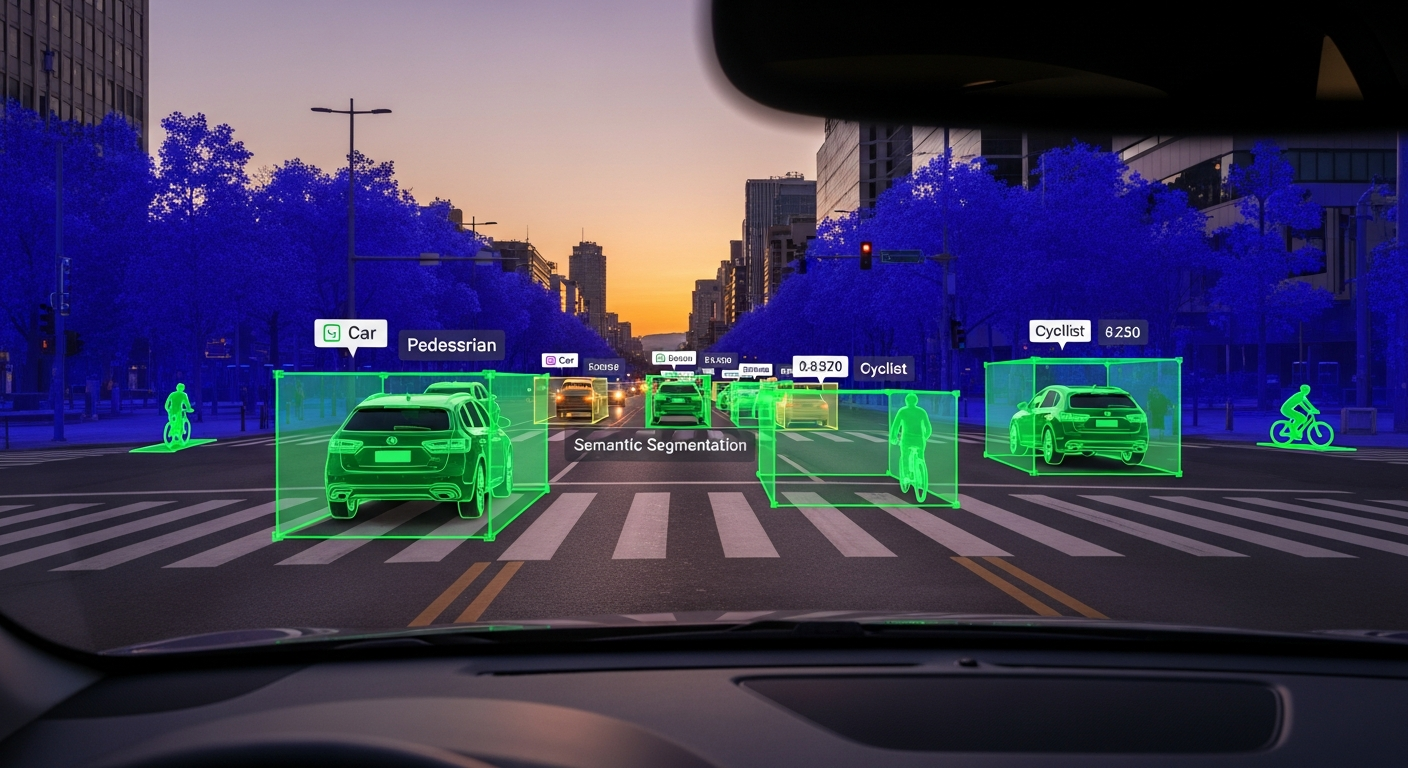
Object detection: Beyond just classifying the whole image, object detection finds where objects are. It draws bounding boxes around each object and labels them. This is how self-driving cars see pedestrians and other vehicles.
Semantic segmentation: This goes further, labeling every pixel in the image. Instead of just putting a box around a cat, it outlines the exact shape of the cat. This is used in medical imaging to outline tumors, and in autonomous driving to understand exactly where the road ends and the sidewalk begins.
Instance segmentation: This combines object detection and semantic segmentation. It identifies each individual object and outlines its exact shape. If there are three cats in an image, it will outline each one separately.
Facial recognition: Systems can detect faces in images, identify specific people, and even estimate age, gender, and emotional expression.
Image generation: Generative models can create realistic images from text descriptions. You can describe "a cat sitting on a chair wearing a tiny hat" and get a plausible image.
Video understanding: Systems can track objects across frames, understand actions (running, jumping, dancing), and even generate descriptions of what's happening in a video.
Real-World Applications
Computer vision is already being used across industries:
Healthcare: Vision systems help doctors detect cancer in medical images, identify abnormalities in X-rays and MRIs, and monitor patients in hospitals.
Autonomous vehicles: Self-driving cars use computer vision to see the road, detect other vehicles and pedestrians, read traffic signs, and navigate safely.
Retail: Vision systems track inventory, analyze customer behavior, and enable cashierless stores.
Manufacturing: Computer vision inspects products for defects, guides robots, and ensures quality control.
Security: Vision systems monitor surveillance footage, detect intruders, and identify potential threats.
Agriculture: Drones and robots use computer vision to monitor crops, detect disease, and optimize harvesting.
The Challenges Remain
Despite remarkable progress, computer vision still has limitations:
Bias: Vision systems can inherit bias from their training data. A system trained mostly on light-skinned faces may perform poorly on dark-skinned faces. This is a serious problem for applications like facial recognition.
Adversarial attacks: Small, imperceptible changes to an image can fool vision systems. An image that looks like a panda to a human can be recognized as a gibbon by a vision system if a tiny bit of noise is added.
Generalization: Systems trained on one type of data may fail on others. A system trained on sunny roads may fail in snow. A system trained on high-quality medical images may fail on images from a different hospital.
Understanding vs. pattern matching: Current vision systems are pattern matchers, not understanders. They don't know that a cat has fur, likes to sleep, and might scratch if annoyed. They just know that certain patterns of pixels are statistically associated with the label "cat."
The Future
Computer vision continues to advance. Researchers are working on:
Few-shot learning: Systems that can learn to recognize new objects from just a few examples.
3D understanding: Moving from 2D images to understanding the 3D structure of the world.
Video understanding: Better models for understanding actions, events, and temporal relationships in video.
Multimodal vision: Systems that combine vision with language and other modalities, enabling richer understanding and interaction.
The Big Picture
Computer vision has come a long way from recognizing simple shapes in controlled conditions. Today's systems can detect objects, understand scenes, generate images, and even track actions across video. They're already transforming industries and creating new possibilities.
But we're still far from human-level vision. Humans can look at a scene and understand not just what objects are present but what's happening, why it's happening, what might happen next, and how we should respond. Building systems that can do that—that truly understand visual scenes—remains one of the grand challenges of artificial intelligence.